The Elephant Is Running the Meeting
Margin 003
The Elephant Is Running the Meeting
October 2026
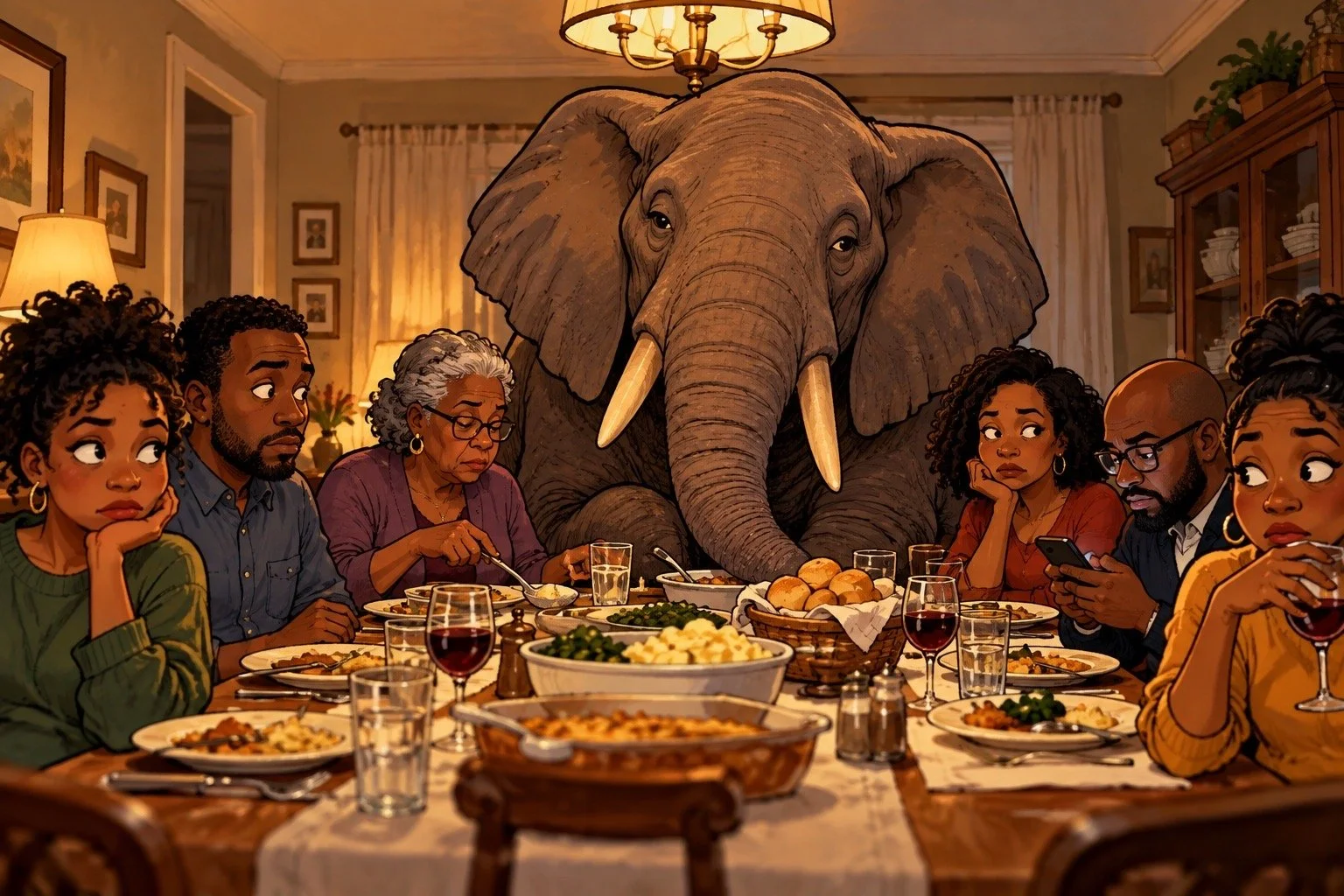
The elephant is already there when everybody sits down.
Of course he is.
He didn't arrive with anyone.
Nobody opened the door for him.
There was no awkward moment where your aunt had to decide whether to take his coat.
He is simply there.
At the table.
Huge.
Everybody sees him.
This is important.
Because later, people are going to behave as though the primary issue is whether anyone can prove there is an elephant.
But for now, dinner.
Someone has moved a chair to make room for him.
Nobody mentions moving the chair.
Your aunt sets down the food and places one dish slightly off-center because the elephant's trunk is in the way.
She doesn't ask him to move it.
She moves the dish.
That's how these things start.
Not with a meeting.
With accommodation.
By the time everyone has a plate, the elephant has taken up enough room that two people are sitting closer together than they normally would.
They don't particularly like each other.
Still nothing.
Then someone says his name.
Not the elephant's.
The other one.
And the room changes.
It's small.
That's what makes it good.
Nobody gasps.
Nobody drops a fork.
Nobody says, Oh, here we go.
People who have known each other for thirty years are much better trained than that.
One person drinks.
One person looks down.
One person looks directly at another person, who does not return the look.
Your aunt asks a question nobody remembers five minutes later.
The elephant lifts his head.
And the name disappears.
Just like that.
This is when you understand who is running things.
The elephant doesn't need to bang a gavel.
Everybody already knows the rules.
One person at this table knows exactly what happened.
Another knows enough.
A third knows what she was told by the person who knows exactly what happened, although later she will become very committed to the phrase I don't know anything about that.
She does.
She called somebody about it Tuesday.
There have been phone calls.
Screenshots.
A “don't say I told you.”
At least one “I knew something was off.”
Possibly a “that's between them,” immediately followed by forty-five additional minutes about them.
The elephant knows this.
So does everybody else.
Still, here at the table, information has become scarce.
Remarkable.
Ask privately and you can get dates.
Ask in front of everybody and suddenly we're dealing with an unsolved mystery.
“I don't know.”
“That's not my business.”
“I wasn't there.”
Nobody was there.
Yet somehow everybody knows what time it happened.
The elephant hasn't moved.
He doesn't need to.
Every so often, someone gets dangerously close.
“I just think it's funny how—”
“No, because you know how she is.”
Interesting.
We have intercepted the sentence before impact.
Dinner continues.
This is the part nobody tells you about elephants in rooms.
They require cooperation.
An elephant cannot run a room by himself.
He needs people.
People willing to move the chair.
People willing to move the dish.
People willing to call something “complicated” when it is actually quite simple but inconvenient.
People willing to become temporarily confused about events they previously explained in extraordinary detail.
People willing to say that's not my business about business they have personally distributed.
It's a group project.
And this group is exceptional.
Until someone isn't.
It is almost always one person.
The person who missed orientation.
The person who is tired.
The person who has watched everybody step around the same enormous animal all night and finally decides this is stupid.
“So we're really not going to talk about it?”
There it is.
Nobody looks at the elephant.
Everybody looks at them.
That tells you everything.
“What is there to talk about?”
Oh, we're good.
Very good.
The elephant is approximately nine feet tall.
A chair is missing because of him.
Your aunt has redesigned the table.
But sure.
What elephant?
“I mean, everybody knows.”
Wrong thing to say.
Because everybody knows is precisely what everybody knows and precisely what nobody was supposed to establish publicly.
Suddenly there are corrections.
Clarifications.
Context.
“I never said—”
“That's not how it happened.”
“You weren't even there.”
Neither were you, Patricia, but Tuesday you had timestamps.
The elephant remains still.
For the first time all evening, nobody else does.
People lean forward.
Sit back.
Cross arms.
Someone who had no information five minutes ago now has a sequence of events.
Someone who said it wasn't their business would like to clarify one thing.
Your aunt is no longer serving anything.
The elephant has the floor.
And he still hasn't said a word.
Eventually, the room exhausts itself.
Not resolves anything.
Let's not get carried away.
Exhausts itself.
There is a difference.
Someone says, “Well, I'm not arguing about it.”
After arguing about it.
Someone else says, “It is what it is.”
The national anthem of conversations that have accomplished nothing.
A plate gets picked up.
A chair moves.
The room begins putting itself back together.
Around the elephant.
Because he isn't leaving.
Why would he?
Nobody asked him to.
Tomorrow, somebody at this table will call somebody else from this table and discuss what happened tonight.
They will be considerably more specific.
By the next gathering, there may be new information.
The elephant may be bigger.
Someone will move another chair.
And everybody will sit down.
As usual.
— Mia
Editor-in-Chief
The Living Room Media House